Showing posts with label 90s. Show all posts

Sunday, February 7, 2016

Music from Doug (1994)

For several years, dating back to a time without a working turntable, and just as this ridiculous cassette craze was beginning, I have been waiting for CDs to get sexy again.  However, in that time, even I went and sold nearly all my CDs and virtually ignored what could have been many goldmines of low-priced, high-quality, un-erasable, un-degradable music.  The popularity of cassettes continued to grow, and crate-diving for records continued to be rewarding as Lewis became a legend all while CDs were phased out of more and more retail environments.

No one crate dives for CDs.  While people will still spend hours searching for funny-looking releases made for 60s grannies and the third world like irony was still entering style, some of the greatest music off all time was being rejected from the most profitable record stores in the world.  Even I have on many times held a jewel box of intriguing mystery and thought "I'd rather keep that dollar."

There are plenty of reasons for this.  Music of the CD era is the worst, and none of your favorite post-hardcore "masterpeices" are going to change that.  CDs are easier to produce than LPs, decreasing the private press success rate from less than one percent to less than point one percent.

That is why when I found myself with time to kill at the Orlando Public Library book store I was surprised to see myself looking so closely through the racks of compact discs.  Mixed in with the garbage were masterpieces like, Paul's Boutique and assorted Bob Mould releases that will continue to be passed over in a city not known for its musical taste.  Assuming it was still cash-only I left a lot behind including this promising nugget with artwork that turned me off from the beginning.

Look up this band for reason why I would be even remotely interested in something that looks like it came out on Asian Man records.
However, after a few minutes I found that holy grail - something I would have bought already had I known it even existed.
Note the other CDs in the background.
Turns out the reason I did not know this existed is because it doesn't really exist.  The note appears to be from "Fred," presumably Fred Newman and is labeled as for promotional use only, leaving one to wonder jsut how many of these exist.  The artwork appears to be printed on a printer - granted one of extremely high quality for 1994, but not a professional printer used by even the lowest-budgeted of labels.  The CD, however, was factory quality, with information printed in a green to match Doug's pathetically uncool sweater vest.

It is noted that this is from the first three seasons (there were four, not counting Disney's imposter version), so not all the hits are there.  In fact, some of the hits may be missing.  I have not listened to the whole disc yet, but I have yet to hear such memorable pieces as "Japanese Restaurant," "Judy's Theme" or my personal favorite, "Cool Shoes."  However, all the Beets songs (except so far for the "Where's My Sock?" fragment and the "My Shoes are Cheap" song that Skeeter sings) are there, and that's most likely what people will enjoy this for most.

Below you can see the beautiful way that the tracks are grouped and titled.  

There isn't much left to say as this music, and the video below really speak for itself, but in case anyone who isn't a nostalgic 90s kid, just know this great music is not just for us.  I would recommend this to any fans of the Residents, Frank Zappa, Ween, the indestructible beat of Soweto, and of course, Mark Mothersbaugh who's excellent work on Rugrats has always overshadowed the brilliant music of this less visually-innovative Nicktoon.

Terri's loss has been all our gain.


UPDATE 6/7/17:

Unfortunately I have had to remove the download here.  I was alerted by one of the artists of the need to do so.  I won't make any assumptions about his position, but I will say it's unfortunate that powers much greater than his own will continue to prevent his work from keeping his reputation growing amongst the people who his music reached.  All I can say is keep digging through those CD bins and try to be as lucky as I have in finding treasures like this one!

Friday, November 22, 2013

The Rise and Fall of Emotion-Wave

Through my formative years it seemed like music was getting more and more emotional, completely out of control.  It affected so many different styles of music and I thought it would never end.  I was born in 1987, and I would say this lasted at least from 1988 to 2005.  I have been wanting to address this topic for a while now and I have the outline a bit clearer now.  I will be pretty harsh on a lot of artists, though some of them I actually like to some extent.  After all, music should be emotional... but there is a limit.  I remember one day in Summer 2005 when that limit was reached, and not just in my opinion.

(The opposite effect, with the shift from the likes of The Smiths and the Cure to the anti-grunge of Britpop was considered as part of this article, but then I remembered that British music hasn't been worth writing about in almost 20 years.)

Part I:  Forming

It can be hard to point out where this all began.  The most obvious argument is the rise of grunge as it is one of those few movements to affect the mainstream and the underground equally.  This is understandable, especially with songs like "Jeremy" being some of the biggest hits of the era.  However, if you look at Nevermind it's pretty balanced emotionally.  It's much more emotional than Poison which was a change for sure, but feelings weren't everything.

Now take how the ultimate - and worst - party band, The Red Hot Chili Peppers breaks out of the marginalized thrash-funk scene and into every home with "Under The Bridge."  When the band who recorded "Party on Your Pussy" and "Fight Like a Brave" has a hit like that, there is no doubt the trend is already in motion.  Another massive 1991 hit that bridges the gap in mainstream and underground rock is "Losing My Religion," by R.E.M..  This song can't be ignored, and is certainly a far cry from "Dr. Feelgood," but actually the rise of underground rock had little to do with the change of pace, it was merely in the right place at the right time.  After all, this is the music that evolved from The Butthole Surfers, Meat Puppets, and Beat Happening.  Additionally, Hüsker Dü's move to the majors did little to intensify the emotion of American rock music.

Dü's, and to a lesser extent, The Replacement's, attempts to reach the mainstream with their emotional brand of American Underground mirrors the actual truth in the larger shift as it was metal's change of mood that really did it.  Perhaps it was the death of this guy...
Cliff Burton, metal skuzz.
His death brought it on, but Metallica's album ...And Justice For All, particularly the hit single "One" that brought the often macho (mainstream), often snarky and ironic (underground), rock scene to weepy boy intensity.  This propelled Metallica into a snowballing success that only grew with their self-titled album highlighted by the hits "The Unforgiven" and "Nothing Else Matters."  When America accepted "sensitive" metal heads it opened the floodgates for all kinds of emotional masturbation in rock music.  If Metallica is not enough of an example, just look at the roughly 140 minutes that make up Guns 'N' Roses' Use Your Illusion project.  "November Rain" was another smash, but it's not the only heartbreaking epic and Axl Rose's sensitive balladeer persona predates even Eddie Vedder's, though hailing from the world seemingly least likely to embrace it.

Part II:  Eddie Vedder Syndrome

Sure, Nevermind had its moments like "Lithium" and "On a Plain," but no one would deny that humor and irony were a huge part of what made Kurt Cobain great.  Not so with San Diego transplant Eddie Vedder.  If you're looking for comedy in Pearl Jam, your search will conclude with Jeff Ament's hat collection.

I believe, there is no need for me to dissect Pearl Jam's debut and its lyrical focus on incest, school shootings, and schizophrenia, or even talk about how intense Vedder is all the time, or even more how - despite what I will say at the conclusion of this article his Ukulele Songs album might actually be the peak of this wave.  What I do need to reinforce is that all these songs, most significantly "Black," were rock radio staples of the era.  Any savvy aspiring rock star aiming to be as big as Zeppelin while playing venues like the Viper Room and the Roxy could tell which way the wind was blowing and quickly dropped songs like "Unskinny Bop" and "Girls, Girls, Girls," in favor of "Counting Blue Cars" and "Sister."

If you were playing rock in the 90s, got airplay, and still sucked you could bet your singer was imitating Vedder, in both vocals and lyrics.  I could go on and on about the kind of dreck that was perpetrated by bands like Seven Mary Three (now country), Days of the New (do you even remember?) and Collective Soul... but I'll keep it to Everclear and Creed.

Though not as much influenced by Pearl Jam, Everclear was the ultimate post-grunge band.  They had the roots in the Northwest and even a sense of humor, but frontman Art Alexakis built his whole image on his willingness to discuss his daddy issues.  While no fan of fathers myself, it is a well-known fact that nothing is less inspired than discussing this topic exclusively.  The fact that America allowed this approach (which was even more repetitive in sound than in subject matter) proved not only that the rock audience was incredibly accepting of this over-emotional garbage, but that it was starving for more and more.

And that is exactly what we got with the Tallahassee, Florida band Creed.  If you are unaware, Creed's first album, which made up a huge portion of every "edge station" playlist for 1998, looks like this:
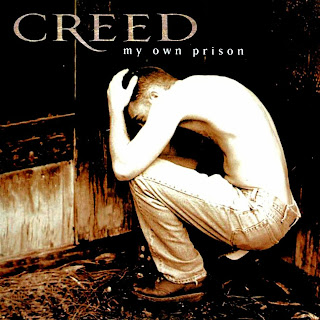
Creed - My Own Prison (1997)
It sounds like that too: a man standing in a fetal position in an abandoned house with no shirt on.  He is wearing shoes, though.  I'll spare everyone else the reminder of what this album, and its follow-ups Human Clay and Weathered sounded like, but this ungodly quartet brought Praisefest intensity to the inescapable masses.  If the most pompous, tattooed junior pastor in the world put all his holy energy and limited intelligence into imitating Eddie Vedder it would sound almost this bad - and almost as emotional.  No matter what bassist Brian Marshall says, it's not as good as Pearl Jam.

I wish my article ended here.

Part III:  No One Is Safe

This is all rock, alt rock for rock fans who love Pearl Jam and believe that sensitivity is a good thing, that it is okay for a man to cry, for a man to stick up for women's rights.  It was the 90s and it had its good points.

Woodstock 99 would paint the picture of a different kind of audience:  destructive, misogynistic, and just plain dangerous with their Family Values Tours and their - you guessed it!  Anger Management Tours.

So let us not forget that anger is a valid emotion as we look at how nü-metal and Eminem were no less a part of this trend than Thursday and Connor Oberst.  Similar to post-grunge I will keep it simple and not pontificate about the heart-wrenching rap-rock of P.O.D., or talk about how even Limp Bizkit released "Rearranged."   I won't even go on about the existence of Linkin Park, but in this case only because it has already been done so well here, or maybe I'll place them in the emo section.  They have more in common with those bands anyway.  So instead I'll focus on the leaders: Korn and Eminem.

To keep things chronological, I'll start with the Bakersfield quintet.  Like all the others in this subsection, anger is their principle emotion.  However, the band's tendency to remain deliberately serious keeps it more consistently emotional than "The Nookie" or "Break Stuff."  I don't need to give much evidence other than these images:
1999
and of course, their video that graphically depicts domestic abuse:
...hard to believe that happened, isn't it?

So, as rap rock became as emotional as the wussies its fans take pride in terrorizing, the natural next step was hip-hop itself - just in time for the arrival of the most legendary white rapper of all time.

While Eminem's sense of humor and endorsement from Dr. Dre may have broken him to the world with hits like "My Name Is" and "Role Model," it was a shock when his follow-up arrived looking like this:
The album containing "The Real Slim Shady"
This album was, and still is, heralded as a masterpiece.  But, this reputation is built less on the MC's ability to rhyme in a creative rhythm or the musicianship of the production, but rather its bludgeoning emotional force.  In true fashion of the times its aggressive, violent emotions are balanced with tracks of a weepier tone, subjecting yet another audience to the belief that artistry is defined by full-frontal emotional nudity.  It would not be the last time a Michigan artist would build his reputation this way.

Part IV:  Short For "Emotional"

Hip-hop is not for everybody, and at the turn of the millennium bands like Creed and the Foo Fighters weren't gut-wrenching enough for a mainstream rock audience that wanted song like "The Way I Am," but with some guitars and harmonies.  That's when Emo stepped in.

I don't have to go through the whole story of Emo that began in the 80s in Washington, DC, then traveled to the other Washington with Sunny Day Real Estate, and then invented itself again with Weezer's Pinkerton a whole five years before the not-particularly-emotional Jimmy Eat World started scoring mislabeled hits.  I don't have to because it's not worthy.  It's only worthy of one sentence.  A run-on sentence, at that.

The real story began a few months later when no teenager in America could escape Dashboard Confessional and "Screaming Infidelities," because somehow many of their peers loved it.  Then there was Thursday, Saves the Day, Taking Back Sunday and so many more.  As rock's popularity continued to wane nu-metal was out, and garage-revival proved unable to connect for long.  By 2003 success was hopeless if you did not jump on the emo bandwagon.  Far removed bands like pop-punk brats Sum 41 rode the wave with "Still Waiting" and fantasy prog-nerds Coheed and Cambria owe their whole career to the emo label.  Before long emo, and its offshoot screamo, became an enduring subculture that has become one of the most maligned globally.  In the US circa 2002, though, it was just the norm.  Even the jocks rocked out to Finch, and even goofballs who knew better were still getting floppy haircuts because it was the only way to get girls.
Emo male

Emo female
The look of emo became synonymous with the music and seeing it let the spectator make no mistake about a person's likelihood to express excessive emotion at any time.  This fashion allowed the intense feeling of the time to manifest itself beyond the radio and MTV and into the public eye wherever the affected went.  In other words, full cultural penetration.  The good part was that any savvy observer would know the breaking point was on its way.

Part V:  Emotion Beyond Comprehension

The militant hardcore types may argue for a clearer and narrower definition of emo, but many, including its fans, saw it in vaguer terms.  Most often these terms included Bright Eyes.  Sometimes, they even included Elliott Smith.  Anyone with an ear for music would be unable to hear what musically these artists had in common with My Chemical Romance or Cursive, or even Mineral, but they certainly fit in line with my argument.

After all, Elliott Smith did commit a very brutal suicide in 2003 after creating the final word in sad music, the works that all sad music shall be compared to for the rest of time.  As for Bright Eyes, he sounded like this in 2005 and I think that keeps with the gradual increase.
Another album came out in 2005 though, one that may have made a bigger impact than any artist I have mentioned after Eminem.  After several records featuring both avante-garde experimentation and a more symphonic take on the Elliott Smith sound, Sufjan Stevens broke into the greater consciousness with Come On Feel the Illinoise, a record as torturously long as the titles to most of its tracks.  His banjo may have charmed some folkier cuts like "Decatur," but this 74-minute album revolves around the most uninspired dreck to pull at the naive heartstrings of college freshmen.  Look no further than the autotune of "John Wayne Gacy Jr." and the half-assed sad childhood lyrics of both of the aforementioned songs to remember how bad it got.  About a year later he released an even longer album of outtakes.  People also loved that.

In truth, the emotional content of the album may not be much worse than its predecessors, but its breakthrough represents the peak of this miserable wave.  In 2005, the coolest thing a sap with a guitar could do was cover "Romulus" or "The Dress Looks Nice On You," and many of those people heard this album first.  Plus "Chicago" is utter garbage.  No one wants a world like that, and living in it exclusively was no fun.

Part VI:  The End?

At least it ended there.  Though Stevens' next album debuted at number 7, it was a real change of pace and his angel-winged figure has not been as visible since "Chicago" became a staple for movie trailers.

Around the same time a new wave of Canadian bands took over the "indie" rock fan base that the previously-mentioned singer-songwriters enjoyed.  Unfortunately Arcade Fire was one of them and this mysteriously-acclaimed (I still can't forgive Bowie) band took over where this movement left off.  We all know what happened next when it comes to this group, but even with enough members to be several groups, they are just one... and even I will admit the lyrics are better.

The indie rock audience remained fickle and went through many phases including animal bands, chillwave, and seapunk, along with so many other sounds.  By now, nothing can be clearly defined, and most will tell you that Sufjan Stevens, The Arcade Fire, and anyone else with more emotion than Deerhunter just isn't cool.

But then again, not everyone is a hipster.  Some people listen to the radio, and gone are all the artists mentioned above, gone is a pop star's need to compete with a heartfelt semi-underground, and it doesn't even seem like Eminem is all that angry anymore.  But, there is one final point about this era and that is, of course, Kanye West.


Clearly, West is a troubled guy and does not have any hesitation when it comes to talking about it.  Why should he?  He's just one man.  But where did it all begin?  He became a household name right at the peak of this emotional movement and some of the most talked-about tracks were "Through the Wire" and "Last Call."  The former is a literally pained vocal not unlike the worst of screamo, and the latter an intense life story - more similar to Elliott Smith than ghetto noir.  Would West have broken through so easily at this time with anything else, such as an album comprised exclusively of his lighter tracks?  I would argue that his rise would have been a little less meteoric.

With so much fanfare surrounding the rise of this movement, it is surprising to see how few noticed when it went away.  The reasons why it happened are as nebulous as its disappearance and therefore it is nearly impossible to predict if it will ever happen again.  Even though many of these artists and their fans got carried away at times, there are worse things that could happen, but I'm still glad it's over.

Saturday, July 20, 2013

New Jersey

So, I have said a lot about New Jersey in this time and for good reason.  Some of the best music of all time has come out of there.  Music from the future, and the really strange thing is that as much as people talk about Maxwell's, Hoboken, Bruce Springsteen, the Misfits, etc., it was oddly enough the small town of Haledon which has the most significance.  Everyone knows the Feelies and many know that's where they come from, they just played Hoboken a lot.

Additionally, many other great bands came out of that Feelies spectrum.  Bands as great and influential on the right artists.  All you need to do is listen to Ridgewood's Real Estate to know that.  So as I have been absorbing such groups lately, both on record and in person I needed to assemble a little playlist for the uninitiated.  I only have what I have so its far from complete and I tried to make it short enough to fit on one CD.  So Here are some flaws:  Nothing from Wake Ooloo, who I have not even heard yet, and this song by Speed the Plough, which may be the greatest song of all time.  I also left out Crazy Rhythms because if you're reading this we can assume you are already familiar with this.

So, these bands...

It starts with the Feelies led by Glenn Mercer and Bill Million.  After the end of their time with Stiff records they were left unoccupied but with a wonderful home studio where they encountered the Trypes (and Yo La Tengo).  The Trypes were John Baumgartner, Toni Peruta, Marc Francia, and Elbrus Kelemet.  Mercer then joined on production.  Eventually so did Dave Weckermen, Brenda Sauter, and Stanley Demeski.  When the Feelies reunited they took those three with them and the remaining members formed Speed the Plough.  Sauter (and I believe Demeski) came back though.  Sauter also joined Wild Carnation with husband Richard Barnes and drummer Chris O' Donovan - both of whom would be members of Speed the Plough.

Then there is Yung Wu, which was essentially the Feelies plus John Baumgartner, but with Weckerman on vocals/songwriting.  These songs cover about 25 years and all but one is original.  If you ask me this is how music is supposed to sound.  Here is the order I planned if anyone wants it that way...

1.  The Trypes - (From the) Morning Glories
2.  Speed the Plough - River Street
3.  Wild Carnation - The Road to Bielefeld
4.  The Feelies - Waiting
5.  Wild Carnation - The State You're In
6.  Speed the Plough - Love Song
7.  The Feelies - Too Far Gone
8.  Yung Wu - Big Day
9.  Speed the Plough - Cardinal Rules
10.  The Trypes - Belmont Girl Is Mad At Me
11.  The Feelies - On the Roof
12.  Wild Carnation - The Rising Tide
13.  Speed the Plough - The Roof Is Off (The Stars Are There And It's Mighty Cold)
14.  Yung Wu - Aspiration
15.  The Feelies - The Undertow
16.  Wild Carnation - Acid Rain and 'The Big One'
17.  Speed the Plough - Big Bus
18.  The Feelies - Invitation
The Trypes - A Plan, Revised (Demo)


This should increase interest in my dream project which I forgot to mention to John and Toni (nee Peruta) Baumgartner to write the long-overdue story of this music scene tentatively titled We All Live on the Western Side:  The Overlooked Story of New Jersey Indie rock with The Feelies Speed the Plough and Yo La Tengo.  Dreams...


Tuesday, October 19, 2010

Standing Before King Everything

This was of course the kind of thing I would give my life for: Two nights in a row of Guided by Voices’ classic lineup in the two best places on Earth.


The first night at Los Angeles’ Wiltern Theater was a special occasion as I was joined not only by fellow GbV devotee Paul Igaz, but by two newcomer friends of ours (including a true Pollard). After a number of canned American macrobrews we were ready to head down the street for the show. Doors were at 7 that night and we arrived at almost 8:30. Missing Times New Viking was an unfortunate but doable sacrifice, but what was surprising was that had the schedule been followed to the T we would have missed some of Guided by Voices set. They started not much later, but as Uncle Bob and company entered the stage with “A Salty Salute,” we learned where out lateness was a mistake. Paul and my attempts to get closer were met with unpermissive security forced us into be the most enthusiastic fans in the middle sea of Hollywood poseurs.


However, as Mitch led us into “Shocker in Gloomtown,” the reassurance that we would have another chance the next night was enough to let it go. The band continued to lead us through all the classics from the obvious “I am A Scientist,” “Motor Away”) to the obscure (“My Impression Now”) with fantastic showmanship not only from the Fading Captain himself, but equally from cohorts Mitch Mitchell and the fantastically dressed Greg Demos. Staging hit its peak with the Tobin Sprout cuts – particularly the ones in which he was joined by Pollard and “Cut-Out Witch” (one of the few Under the Bushes Under the Sttars cuts played.) Bob hit us with all his classic moves – the windmills, the kicks, the hops, yet kept them in check to give his band the credit they deserve.


At San Francisco’s Warfield even more friends joined me after an invigorating drive across the Bay Bridge. This time Times New Viking confirmed their importance as one of today’s best bands leaving me, unlike the rest of my crowd speechless. They evoked not only their all-encompassing home state, but some of the cosmic power of Young Marble Giants with Beth Murphy reminding me of an awkward Chrissie Hynde and Adam Elliott as the greatest singer songwriter to sit behind a drum kit.

Then it really started. Was this show better than the one in LA? It is impossible to say, but what I can say is this: Being much closer to the stage surrounded by people who know every word to “Gleemer (the Deeds of Fertile Jim),” “Smothered in Hugs,” and the symphonic high of “Don’t Stop Now” one can only think of commercials for Christian rock compilations for comparison. You know, the ones where the massive audience throws their collective hands towards the sky in transcendent ecstasy. It was like that, but with a lot more motion in the body, a bit hard to stay on your feet, well, and beer, obviously. Likewise the new proximity to the stage allowed me to finally witness the legendary “crazy Kevin face” which was all its cracked up to be possibly due to, or perhaps despite the fact that Mr. Fennell had aged particularly well in spite of the worst substance abuse.


While the songs were the same, some things differed between the shows. Perhaps this was only due to the location of my party, but the SF show was much more male-dominated, yet despite all your outsider sneering had no apparent gay element to it. Obviously Guided by Voices, right? On a similar note, The Los Angeles show featured a long string of banter between Pollard and Mitchell on the topic of Los Angeles pussy, which I am sure was enjoyed by all single members of the group particularly Mitch. The Los Angeles show also featured a great rush to the stage on “Motor Away,” in which at least 30 people joined the band onstage to everyone’s delight. This was not repeated, but neither was Pollard’s improvisation on “Lethargy” which reminded us that no one in the band gives a fuck, so why should we?


With all the songs intact the band changed it up a little bit by switching from two encores into three, but both ended the same way. First a sing-along epic rendition of “Johnny Appleseed,” and the closer to end all closers “Weedking” in which Uncle Bob sends his fans home early with the right idea I am sure almost all of us followed.


That’s right you will be home early to give your own neighborhood a taste of the Monument Club where you can watch your newly initiated friends transform from child to Official Iron (Wo)Men. That’s all you’re getting. Gotta leave some surprises for you suckers on the East Coast.


But here’s one they certainly won’t be swinging in Boston: Mitch has maintained the cigarette with unfathomable constancy and at many point, so does Pollard.

Monday, January 25, 2010

The Vaccine to Hearing Loss

Whether you love or hate Antone Newcombe this is going to make you feel stronger either way.


Now, despite what Newcombe says in the above video it is not as easy as you might hope to find all of his music on the internet. After struggling though, I did.

This release, I feel, is particularly important to share as the usual and understandable place to start with BJM is Tepid Peppermint Wonderland: A Retrospective. This album was recorded on TVT Records, which as we all know may function more like a major than any other indie. Though actually with even less patience as this was BJM's only record with them, and they were followed by an almost as brief period with GbV. Naturally, the label would not share these tracks for that wonderful compilation. It sure is a shame as the band was on a roll as much as ever and the record highlights many of the band's strong points.

Recorded during their time in Los Angeles, their sound is rooted as much in 60s psychedelia and the Velvets as ever. However, his album named after an 80s Bowie quote not only is the most typically 90s indie rock I've heard from them but also explored the subtle nuances of 90s psychedelia revivalists. There is no better example of this than the Elephant 6 (Specifically Gerbils-esque) pop of "Jennifer," besides maybe "Dawn" with Newcombe seeming emulating Wayne Coyne. Likewise the magnificent opener "Going to Hell" Newcombe gets in touch with his inner Dylan more than just musically to outstanding results. Tracks like "Nothing to Lose," "Dawn," and "Lantern," are typical BJM at their finest being the perfect medium between Spacemen 3 and Rain Parade. This album is a little more acoustic guitar and organ heavy than a lot of BJM's other work, but not of course with any less of Joel Gion's famous tambourine. Keep the revolution going!


The Brian Jonestown Massacre - Strung Out in Heaven (1998)

Tuesday, December 15, 2009

When I Saw You There I Saw The Best Part of Me Was Yourself


As a true Official Iron Man, I would, of course consider Robert Pollard the greatest songwriter ever. Beyond that, I would say the other contributing member of GbV and father of their lo-fi sound Tobin Sprout is the second. Anyone who has fairly listened to their records Propeller through Under The Bushes Under The Stars need not question why. After all where would those albums be if not for classics like "Ester's Day," "A Good Flying Bird," "Little Whirl," "14 Cheerleader Coldfront," or "To Remake the Young Flyer" Slightly less deserving as the greatest records of all time, that's where. Well, here's an entire album of that kind of thing.

This album, release concurrently with Pollard's Not In My Air Force, the initial reaction to Sprout's now out-of-print album was more favorable than Pollard's unexpectedly experimental piece. This one fits in noticeably more with the prior three GbV releases than that album does. In fact, one of the most recent album's standout tracks, "It's Like Soul Man" is re-recorded here - actually with a more clean and professional recording. Luckily it's not even the best song as "My Beloved Martha" and "E's Navy Blue" manage to outdo that GbV masterpiece. that is not to say they are the only two. Really this album is as solid as most of GbV's LPs and to be frank, maybe even better than average. It is the perfect for anyone who ever wished for just a bit more of "You're Not An Airplane."


Tobin Sprout - Carnival Boy (1996)

Monday, September 7, 2009

I'm On a Cloud, I Must Be In A Dream


These days, a lot of attention is paid to all the classic punk groups getting back together. Many forget that the Buzzcocks did that long before and released a few albums in the 90s. They weren't that bad even!

Years ago, before the group got their fair share of the reissue game it was actually the easiest to find these newer releases. That's why over eight years ago when getting more and more curious about the band my friend Tommy made this his first Buzzcocks acquisition. What a unique one it was. Starting off with krautrock synths on the album's best track "Soul on a Rock" Pete Shelley's pre-punk forays into synth music is heard in his punk work - something absent from the Buzzcocks' classic work. Both his and Steve Diggle's songwriting is intact, creating songs in most ways similar to their seventies and eighties work albeit with a cleaner 90s production and a little more experimentation in arrangement. That being said, you can't entirely expect the same music from the same kitchen, but if your mind is a little open I think you can handle it. The title is a little bit of an indicator, but it would be a little bit better suited a few years after the group's initial break-up rather than 1999. The album is a solid one with more poppy punk songs with plus the krautrock influence the members never got to show off like their other punk contemporaries got to. The band even ventures into more dance territory on "Why Compromise?," while it is admittedly a step down from the preceding 4 tracks it is a good curiosity. This is essential for anyone who enjoyed the High Water Marks' Songs About the Ocean as much as I did. It is clear that in middle age the Buzzzcocks had not lost their greatness.


Buzzcocks - Modern (1999)

Friday, September 4, 2009

Woke Up Screaming "God I Hope I'm Not Bleeding!"


I went with a recent photo for the irony. I have not listened to that much Built to Spill in a while, but this weekend after "Ze" telling me about their performance at Outside Lands they have been on my mind. Like my friend was after their set I was just a little disappointed when I saw them about four years ago. Now, a lot of that had to do with weak openers, but also because my friends who had seen them two years prior seemed to have gotten an unusually remarkable set from them featuring VERY early work.

I am one of the few that think the band got slightly weaker with each album, thusly implying that the debut is the best. In addition to having the best album and best cover it in fact has the best music. But, it has been out of print (actually, I think just decent distribution) for who knows how long? It captures the band at their best offering both the pop of There's Nothing Wrong With Love and Ancient Melodies of the Future AND the jammy epics of Perfect From Now On and Keep It Like A Secret all with classic 90s lo-fi recording. One could argue that the band may not have the chemistry they would later have as a solid line-up'ed band, but with songs and energy like this who cares? It is particularly odd this did not catch on more as its heavy guitars and playfully angsty lyrics, in addition to the band's Boise home town could have given it a grunge audience at the time. Everything just comes together in such sloppy glory and Greg Martsch's affinity for stacks of guitar tracks shines through, particularly on the simple, yet wailing "Get A Life." "Lie for a Lie," the album's catchiest and shortest song with its goofy samples and white nose tracks stands with The Olivia Tremor Control's "Love Athena" as definitive 90s US indie pop. Its line "Once in a while there's a girl I don't know in my dreams/ she reminds me of a lot of people, but she's someone that I've never seen/ and she's perfect" was the star of numerous bonding moments during my teenage years. However, the star of the show is probably "Nowhere, Nothin', Fuckup" which showcases the band's remarkable talent for jamming on something familiar and turning it into their own masterpiece while making the title a fun little sing-along. This is essential American indie rock. A lost masterpiece.


Built to Spill - Ultimate Alternative Wavers (1993)

Tuesday, July 28, 2009

I'm Gonna Leave This Party Now


The KLF really really knew their shit. If the sample of Arthur Russell (Dinosaur L)'s "Go Bang!" at the end of "Go To Sleep" doesn't prove that I don't know what will.

This group is what happened when two underground rock veterans out of the already unique scene in Liverpool decide to reinvent pop culture for the 90s and succeeded - this album's opener "Kylie Said to Jason" and Drummond's white rapping prove this. While few, at least in this country (where they were in fact pretty successful at the time) remember them, 90s mainstream culture (playing what was often called "stadium house") was in many ways created by this band whose political commentary and postmodern sound basically came from 20 years in the future. ...If only 20 years later could have music this good. If you don't believe that check out their successful mash-up from 1988 below. They made the music Kanye West would wish he could have if he had taste. There is so much to say about the KLF, I could go on forever, so I''ll just stop now and get to this album...

It is hard to imagine just what the film The White Room would have been like had it been made. Certainly like nothing else in history, judging not only by the KLF's bizarre videos but just how epic its unreleased soundtrack is. The power of songs like "No More Tears" and "Build A Fire" is undeniable and the imagine a film that could carry them will simply blow one's mind. Like in much of the KLF's work every style is sampled replicated and perfectly accompanied by standard electronic instruments of the time to create a truly postmodern sound. This could definitely be called the A Wizard, A True Star of the 1990s. This is an engaging trip through a psychedelic 90s disco from beginning to end and will surely change the way you think about music and, really all performing arts. It can stand cheesy at times, but consciously, knowing that in the short term it would be embarassing. The KLF guarenteed a legacy that would come, go, and then stay stronger than ever. One of the top artistic achievements of our time. I'll stop now.

Dedicated to

The KLF - The White Room: Original Motion Picture Soundtrack (1991)


The Timelords - "Doctorin' the Tardis" (1988)


Dedicated to the people of the Caucasian nations, where it is almost 3 A.M. (Eternal).

Wednesday, July 22, 2009

The Ultimate Rock 'N' Roll Legend


On August 15, 1990, the U.S.S.R.'s top musician Viktor Tsoi died in an massive car wreck after fishing in Latvia. Miraculously, the one thing that survived intact was a tape of his vocal tracks for the next album. With those tracks his surviving band members recorded KINO's posthumous masterpiece known typically as "The Black Album."

This is often considered the band's greatest work despite the entire musical tracks being recorded after Tsoi's death. However, it sounds as good, if not better than all the other records and it is hard to beleive it was recorded under such conditions. Like in all KINO's other works, that power to transcend not only the language, but their language's poor aesthetics (sorry) is there. However, it is at its most powerful here and every song is a winner. The band's post-New Wave sound is tighter than ever and Yuriy Kasparyan's guitar excels. These catchy and hypnotic songs stick into one's subconscious forever and permanently capture the last days of Glasnost and Parastroika. It makes you really wonder whether Tsoi's death before the fall of the U.S.S.R. was tragic, lucky for him, or even how he could have altered the Russia's unfortunate future. The dark yet hopeful lyrics reflect this unique time in world history on two of the album's best songs, opener "Кончится Лето (Summer Will Soon Be Over)" and (Красно-желтые Дни )Red and Yellow Days)," as does the plaintive "Кукушка (Cuckoo)," one of their best songs. "Звезда (Star)" is one of their best songs and has a cool, simple beat that any fan of New Order or Duran Duran would have to love. "Когда твоя девушка больна (When Your Girlfriend is Sick)" is one of the band's sweetest pop songs yet somehow fits in this heavy set quite well showing how much of a range Tsoi had as a songwriter, hinting at what kind of music he may have made if he lived to see the overly optomistic years following his death. This is perhaps KINO's best work and in many ways the best place to start with this remarkable band and proves that had Tsoi survived they would most likely have caught on outside the Eastern Block.


Кино (KINO) - Кино (KINO) a.k.a. Чёрный альбом (The Black Album) (1990)


Now, on a totally unrelated note, I had the unusual privelige to see 90s pop favorites Sugar Ray at Best Buy on Pico here in Los Angeles last night. I was informed about this by my friend Tommy who is working for Rocket Science, who works for the band. It was a fun way to relive 1999, and the band knew it would hardly be more than that and htey seemd to be enjoying themselves. The set even began with Mark "Mr. Ray" McGrath asking "who wants to hear the number one song of 1999?!" before going straight into "Every Morning." The set consisted of only a few songs including just one from the new album, one cover, and on top of "Every Morning," "Fly" and "Someday." I am sure no one was disappointed... well maybe the band was hoping for a bigger turnout, but they sure didn't show it. As tiresome as it may have gotten ten years ago, you gotta give the band some credit for doing what they know they do well, enjoying themselves, and having a good attitude. After all, weren't all thsoe hits better than anything that's been on pop radio since?

Saturday, July 11, 2009

We Got Road, We Got Time, So We're Outta Here...


So, as much as I dislike posting two albums by the same artist close together, I promised something of a section on desert rock, so here's another one. Most likely the last one for a while.

This one went out of print later than the other two London releases from the Puppets, but that's not why it is so easy to find. This is available in any used CD section in the United States thanks to Nirvana. Released in early 1994 after the tour and famous MTV Unplugged set, this was unarguably the Puppets' most mainstream and most successful work. That is not to say it is not great as well. Cleaner and grungier (wtf?) than even the previous album, this one does in fact carry their tradition well and modern rock radio hit "Backwater" is awesome, no matter what some detractors may say. In many ways other tracks like "Never to Be Found" really pick up where Forbidden Places left off and "Evil Love" really wails. As hard rock as the band can get on the album, the Southwestern sound is never completely buried by 90s production and preciesely distorted guitars. "Flaming Heart," probably the strongest song on the set is the ultimate testament to the matured band that brought us all their masterpieces in the previous decade. The grunge era was in fact kind to the Meat Puppets, unlike some of their other comtemporaries, the only exception being the hidden track - a re-recording of "Lake of Fire" done in the style of the Nirvana cover, which of course, was maybe the album's biggest mainstream draw. If you ask me, Mr. Cobain certainly did not do those classics justice. This is just another worthy Meat Puppets album, and in many ways the perfect 1994 rock album.


The Meat Puppets - Too High to Die (1994)

Sunday, July 5, 2009

The Weight Was Wasted


It may seem hard to believe now, but in the mid-90s the Archers of Loaf were considered about as vital to the landscape of American Indie rock as Pavement, Guided by Voices, and Built to Spill. The Chapel Hill group definitely brought their own sound to the table and really reflected the times.

Considering how much heavier than their peers the band should have probably fared better in the grunge 90s, but either way those who really know their music know this album is an essential part of the era. The ironic-aggressive lyrics and sound delivered with a generours dose of fun (see "Learo, You're a Hole") could only come out of a college town in the 90s and rather than being really timeless, the album serves as a perfect time capsule, and that should be remembered when listening to it. That being said, the songwriting is very tight especially on the classic opening track "Web In Front" and "Wrong." While their certain, hardcore-like (the connection is as strong on as macho-man group Give Up the Ghost even covered this album's "You and Me") energy makes them quite distinguishable, this is a place to hear some ultimate 90s indie guitar riffs, especially on "Might" and "Plumb Line."

This, I believe, is in print, but for a long time - like when I got it for a whole lot of money on eBay six years ago, was out, or at least not being well-distributed. For uninitiated Eric Bachmann fans, it must be noted that this sounds nothing like his solo work or Crooked Fingers.


Archers of Loaf - Icky Mettle (1993)

Wednesday, July 1, 2009

Maybe I Had A Different Opinion That Nobdy Ever Considered Important

Well it's been a hectic past few days, hence the pause in updates. Just been very busy with my arrival in Los Angeles living the "J" Fantasy, moving, and ultimately having all the difficulties with wireless and other equipment affected by such things.


Along the cross-country drive, which has been a noticeable theme as of late I spent a lot of time in the desert, which as a Northeast kid is really something new. It certainly made an impact, especially the brief turn in I-15 through Arizona. I had plenty of desert rock in tow for this portion. Tonight I begin what will be a noticeable, but not exclusive feature on that style.

I have always been a Meat Puppets fan, but seeing the group's home turf really added even more to that. This album, one that has been out of print for many years, and as a major label debut - stemming from a deal that caused the then-defunct band to reunite, is not uncommonly maligned. However, it is one of my favorites - perhaps the most after the legendary II and Up On The Sun. Many people are not familiar with it, unfortunately, but the Kirkwoods lived out my ultimate dream (for the context) and opned their mind-blowing perfomance at the Middle East downstars September 2007 with this album's opener "Sam." The fast-paced blast of cowpunk energy was the perfect way to start a legendary show.

The album does not wane from there one bit. "This Day" is reminiscent of the feel-good psychedelia of Up On The Sun even as the next track shows the band outdoing their own straightforward hard rock style heard in their later 80s work. The pattern continues through the whimsical psychobabble of "Whirlpool," and rockers like "Popskull," but what is a Meat Puppets record without the cowboy campfire sound of "That's How It Goes" or frenetic insturmental "Six Gallon Pie"?

Essential for even casual listners of the group.

Meat Puppuets - Forbidden Places (1991)