Showing posts with label grunge. Show all posts

Friday, November 22, 2013

The Rise and Fall of Emotion-Wave

Through my formative years it seemed like music was getting more and more emotional, completely out of control.  It affected so many different styles of music and I thought it would never end.  I was born in 1987, and I would say this lasted at least from 1988 to 2005.  I have been wanting to address this topic for a while now and I have the outline a bit clearer now.  I will be pretty harsh on a lot of artists, though some of them I actually like to some extent.  After all, music should be emotional... but there is a limit.  I remember one day in Summer 2005 when that limit was reached, and not just in my opinion.

(The opposite effect, with the shift from the likes of The Smiths and the Cure to the anti-grunge of Britpop was considered as part of this article, but then I remembered that British music hasn't been worth writing about in almost 20 years.)

Part I:  Forming

It can be hard to point out where this all began.  The most obvious argument is the rise of grunge as it is one of those few movements to affect the mainstream and the underground equally.  This is understandable, especially with songs like "Jeremy" being some of the biggest hits of the era.  However, if you look at Nevermind it's pretty balanced emotionally.  It's much more emotional than Poison which was a change for sure, but feelings weren't everything.

Now take how the ultimate - and worst - party band, The Red Hot Chili Peppers breaks out of the marginalized thrash-funk scene and into every home with "Under The Bridge."  When the band who recorded "Party on Your Pussy" and "Fight Like a Brave" has a hit like that, there is no doubt the trend is already in motion.  Another massive 1991 hit that bridges the gap in mainstream and underground rock is "Losing My Religion," by R.E.M..  This song can't be ignored, and is certainly a far cry from "Dr. Feelgood," but actually the rise of underground rock had little to do with the change of pace, it was merely in the right place at the right time.  After all, this is the music that evolved from The Butthole Surfers, Meat Puppets, and Beat Happening.  Additionally, Hüsker Dü's move to the majors did little to intensify the emotion of American rock music.

Dü's, and to a lesser extent, The Replacement's, attempts to reach the mainstream with their emotional brand of American Underground mirrors the actual truth in the larger shift as it was metal's change of mood that really did it.  Perhaps it was the death of this guy...
Cliff Burton, metal skuzz.
His death brought it on, but Metallica's album ...And Justice For All, particularly the hit single "One" that brought the often macho (mainstream), often snarky and ironic (underground), rock scene to weepy boy intensity.  This propelled Metallica into a snowballing success that only grew with their self-titled album highlighted by the hits "The Unforgiven" and "Nothing Else Matters."  When America accepted "sensitive" metal heads it opened the floodgates for all kinds of emotional masturbation in rock music.  If Metallica is not enough of an example, just look at the roughly 140 minutes that make up Guns 'N' Roses' Use Your Illusion project.  "November Rain" was another smash, but it's not the only heartbreaking epic and Axl Rose's sensitive balladeer persona predates even Eddie Vedder's, though hailing from the world seemingly least likely to embrace it.

Part II:  Eddie Vedder Syndrome

Sure, Nevermind had its moments like "Lithium" and "On a Plain," but no one would deny that humor and irony were a huge part of what made Kurt Cobain great.  Not so with San Diego transplant Eddie Vedder.  If you're looking for comedy in Pearl Jam, your search will conclude with Jeff Ament's hat collection.

I believe, there is no need for me to dissect Pearl Jam's debut and its lyrical focus on incest, school shootings, and schizophrenia, or even talk about how intense Vedder is all the time, or even more how - despite what I will say at the conclusion of this article his Ukulele Songs album might actually be the peak of this wave.  What I do need to reinforce is that all these songs, most significantly "Black," were rock radio staples of the era.  Any savvy aspiring rock star aiming to be as big as Zeppelin while playing venues like the Viper Room and the Roxy could tell which way the wind was blowing and quickly dropped songs like "Unskinny Bop" and "Girls, Girls, Girls," in favor of "Counting Blue Cars" and "Sister."

If you were playing rock in the 90s, got airplay, and still sucked you could bet your singer was imitating Vedder, in both vocals and lyrics.  I could go on and on about the kind of dreck that was perpetrated by bands like Seven Mary Three (now country), Days of the New (do you even remember?) and Collective Soul... but I'll keep it to Everclear and Creed.

Though not as much influenced by Pearl Jam, Everclear was the ultimate post-grunge band.  They had the roots in the Northwest and even a sense of humor, but frontman Art Alexakis built his whole image on his willingness to discuss his daddy issues.  While no fan of fathers myself, it is a well-known fact that nothing is less inspired than discussing this topic exclusively.  The fact that America allowed this approach (which was even more repetitive in sound than in subject matter) proved not only that the rock audience was incredibly accepting of this over-emotional garbage, but that it was starving for more and more.

And that is exactly what we got with the Tallahassee, Florida band Creed.  If you are unaware, Creed's first album, which made up a huge portion of every "edge station" playlist for 1998, looks like this:
Creed - My Own Prison (1997)
It sounds like that too: a man standing in a fetal position in an abandoned house with no shirt on.  He is wearing shoes, though.  I'll spare everyone else the reminder of what this album, and its follow-ups Human Clay and Weathered sounded like, but this ungodly quartet brought Praisefest intensity to the inescapable masses.  If the most pompous, tattooed junior pastor in the world put all his holy energy and limited intelligence into imitating Eddie Vedder it would sound almost this bad - and almost as emotional.  No matter what bassist Brian Marshall says, it's not as good as Pearl Jam.

I wish my article ended here.

Part III:  No One Is Safe

This is all rock, alt rock for rock fans who love Pearl Jam and believe that sensitivity is a good thing, that it is okay for a man to cry, for a man to stick up for women's rights.  It was the 90s and it had its good points.

Woodstock 99 would paint the picture of a different kind of audience:  destructive, misogynistic, and just plain dangerous with their Family Values Tours and their - you guessed it!  Anger Management Tours.

So let us not forget that anger is a valid emotion as we look at how nü-metal and Eminem were no less a part of this trend than Thursday and Connor Oberst.  Similar to post-grunge I will keep it simple and not pontificate about the heart-wrenching rap-rock of P.O.D., or talk about how even Limp Bizkit released "Rearranged."   I won't even go on about the existence of Linkin Park, but in this case only because it has already been done so well here, or maybe I'll place them in the emo section.  They have more in common with those bands anyway.  So instead I'll focus on the leaders: Korn and Eminem.

To keep things chronological, I'll start with the Bakersfield quintet.  Like all the others in this subsection, anger is their principle emotion.  However, the band's tendency to remain deliberately serious keeps it more consistently emotional than "The Nookie" or "Break Stuff."  I don't need to give much evidence other than these images:
1999
and of course, their video that graphically depicts domestic abuse:
...hard to believe that happened, isn't it?

So, as rap rock became as emotional as the wussies its fans take pride in terrorizing, the natural next step was hip-hop itself - just in time for the arrival of the most legendary white rapper of all time.

While Eminem's sense of humor and endorsement from Dr. Dre may have broken him to the world with hits like "My Name Is" and "Role Model," it was a shock when his follow-up arrived looking like this:
The album containing "The Real Slim Shady"
This album was, and still is, heralded as a masterpiece.  But, this reputation is built less on the MC's ability to rhyme in a creative rhythm or the musicianship of the production, but rather its bludgeoning emotional force.  In true fashion of the times its aggressive, violent emotions are balanced with tracks of a weepier tone, subjecting yet another audience to the belief that artistry is defined by full-frontal emotional nudity.  It would not be the last time a Michigan artist would build his reputation this way.

Part IV:  Short For "Emotional"

Hip-hop is not for everybody, and at the turn of the millennium bands like Creed and the Foo Fighters weren't gut-wrenching enough for a mainstream rock audience that wanted song like "The Way I Am," but with some guitars and harmonies.  That's when Emo stepped in.

I don't have to go through the whole story of Emo that began in the 80s in Washington, DC, then traveled to the other Washington with Sunny Day Real Estate, and then invented itself again with Weezer's Pinkerton a whole five years before the not-particularly-emotional Jimmy Eat World started scoring mislabeled hits.  I don't have to because it's not worthy.  It's only worthy of one sentence.  A run-on sentence, at that.

The real story began a few months later when no teenager in America could escape Dashboard Confessional and "Screaming Infidelities," because somehow many of their peers loved it.  Then there was Thursday, Saves the Day, Taking Back Sunday and so many more.  As rock's popularity continued to wane nu-metal was out, and garage-revival proved unable to connect for long.  By 2003 success was hopeless if you did not jump on the emo bandwagon.  Far removed bands like pop-punk brats Sum 41 rode the wave with "Still Waiting" and fantasy prog-nerds Coheed and Cambria owe their whole career to the emo label.  Before long emo, and its offshoot screamo, became an enduring subculture that has become one of the most maligned globally.  In the US circa 2002, though, it was just the norm.  Even the jocks rocked out to Finch, and even goofballs who knew better were still getting floppy haircuts because it was the only way to get girls.
Emo male

Emo female
The look of emo became synonymous with the music and seeing it let the spectator make no mistake about a person's likelihood to express excessive emotion at any time.  This fashion allowed the intense feeling of the time to manifest itself beyond the radio and MTV and into the public eye wherever the affected went.  In other words, full cultural penetration.  The good part was that any savvy observer would know the breaking point was on its way.

Part V:  Emotion Beyond Comprehension

The militant hardcore types may argue for a clearer and narrower definition of emo, but many, including its fans, saw it in vaguer terms.  Most often these terms included Bright Eyes.  Sometimes, they even included Elliott Smith.  Anyone with an ear for music would be unable to hear what musically these artists had in common with My Chemical Romance or Cursive, or even Mineral, but they certainly fit in line with my argument.

After all, Elliott Smith did commit a very brutal suicide in 2003 after creating the final word in sad music, the works that all sad music shall be compared to for the rest of time.  As for Bright Eyes, he sounded like this in 2005 and I think that keeps with the gradual increase.
Another album came out in 2005 though, one that may have made a bigger impact than any artist I have mentioned after Eminem.  After several records featuring both avante-garde experimentation and a more symphonic take on the Elliott Smith sound, Sufjan Stevens broke into the greater consciousness with Come On Feel the Illinoise, a record as torturously long as the titles to most of its tracks.  His banjo may have charmed some folkier cuts like "Decatur," but this 74-minute album revolves around the most uninspired dreck to pull at the naive heartstrings of college freshmen.  Look no further than the autotune of "John Wayne Gacy Jr." and the half-assed sad childhood lyrics of both of the aforementioned songs to remember how bad it got.  About a year later he released an even longer album of outtakes.  People also loved that.

In truth, the emotional content of the album may not be much worse than its predecessors, but its breakthrough represents the peak of this miserable wave.  In 2005, the coolest thing a sap with a guitar could do was cover "Romulus" or "The Dress Looks Nice On You," and many of those people heard this album first.  Plus "Chicago" is utter garbage.  No one wants a world like that, and living in it exclusively was no fun.

Part VI:  The End?

At least it ended there.  Though Stevens' next album debuted at number 7, it was a real change of pace and his angel-winged figure has not been as visible since "Chicago" became a staple for movie trailers.

Around the same time a new wave of Canadian bands took over the "indie" rock fan base that the previously-mentioned singer-songwriters enjoyed.  Unfortunately Arcade Fire was one of them and this mysteriously-acclaimed (I still can't forgive Bowie) band took over where this movement left off.  We all know what happened next when it comes to this group, but even with enough members to be several groups, they are just one... and even I will admit the lyrics are better.

The indie rock audience remained fickle and went through many phases including animal bands, chillwave, and seapunk, along with so many other sounds.  By now, nothing can be clearly defined, and most will tell you that Sufjan Stevens, The Arcade Fire, and anyone else with more emotion than Deerhunter just isn't cool.

But then again, not everyone is a hipster.  Some people listen to the radio, and gone are all the artists mentioned above, gone is a pop star's need to compete with a heartfelt semi-underground, and it doesn't even seem like Eminem is all that angry anymore.  But, there is one final point about this era and that is, of course, Kanye West.


Clearly, West is a troubled guy and does not have any hesitation when it comes to talking about it.  Why should he?  He's just one man.  But where did it all begin?  He became a household name right at the peak of this emotional movement and some of the most talked-about tracks were "Through the Wire" and "Last Call."  The former is a literally pained vocal not unlike the worst of screamo, and the latter an intense life story - more similar to Elliott Smith than ghetto noir.  Would West have broken through so easily at this time with anything else, such as an album comprised exclusively of his lighter tracks?  I would argue that his rise would have been a little less meteoric.

With so much fanfare surrounding the rise of this movement, it is surprising to see how few noticed when it went away.  The reasons why it happened are as nebulous as its disappearance and therefore it is nearly impossible to predict if it will ever happen again.  Even though many of these artists and their fans got carried away at times, there are worse things that could happen, but I'm still glad it's over.

Wednesday, August 7, 2013

Roots, Part 6: (Winding) Ways

Alex Adler, George McTernan, C-Mac
There was another barren period, this time also lasting about three years, but it was perhaps even more barren and a lot of it had to do with not even having an instrument with me when I moved to LA in June of 2009.  That changed slightly over a year later when my family visited.  I needed the thing back no matter what, but it was heightened by the possibility of the Funbeatles losing a member.  Luckily for everyone other than me that never happened.  The bass was useful when I moved to Alameda at the end of 2010, though, but I would not be in a proper band until the following Spring when I returned to LA.

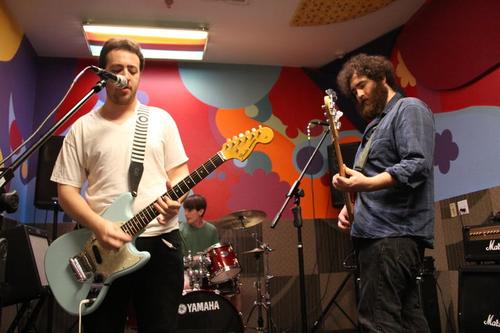
That band was Ways, also known as Winding Ways and sometimes The Ways.  It was led by my college friend Alex Adler who had amassed a large quantity of songs, ideas, and titles, all of which impressed me, such as "Inner Moon," "Alive In Well," "(Oh) Family," "Ocean Vision" and many more.  Just looking forward to playing again, we began and all too quickly found drummer and recent transplant from New England George McTernan.

We began weekly sessions at Echo Park's ultra-hip rehearsal space Bedrock (where less than a year later Super River would be) and got to work on this wide body of songs.   Some of the first were "Zero The Astronaut," "On Pleasure Pier," "Discipline" and "Vice/Versa."  The band's influences were mostly of the 80s and 90s rock type like grunge, shoegaze, and American Underground, though with some space-rock in there too.  Some more specific inspirations were the Wipers, Meat Puppets, and Bobb Trimble, with Adler's dominant guitar style evoking a lot of John Frusciante, Curt Kirkwood, and Trimble.  Those four early songs were recorded in early May by Paul Igaz in his legendary basement with him on drums.  I unfortunately do not have these demos at the moment which is tragic as they may be the best recordings and Igaz' drum style is quite different from McTernan's which offers a very different interpretation of these songs.

Brady Nelson played with us a few times on synth, but we were unsure how needed that was and schedules were not ideal.  Through that Summer we kept playing and our setlist grew and grew into an exciting little show.  That show was finally put on display at the embarrassing Highland Park venue Mr. T's Bowl with current Los Angeles buzz band Spaceships and a "punk" band called Dog Teeth or something, who I guess has a cassette or something.  I found them unpleasant, but Spaceships was great.  We got that show through their bassist Schuyler Stone, also of Benefit Friends (who departed that November for New York) who also, through them got Super River a nice show at Silver Lake Lounge a year later.  It went well for the most part, other than my amp being a bit too loud and my mic being way too loud as the sound guy was not expecting my screams on "Pheonix" which on a good night like that were pretty ear-piercing.

We recorded nearly every rehearsal to varying success.  The vocals were often far too low.  We used some kind of good machine I've seen before, but an iPhone probably would have worked better as it did for Super River.  There were also some really great videos made with the help of Adler's room mate Hee-Jae Park, but those have been taken down.  These are probably the rawest recordings I will share.  Not our best performances nor best sound quality and I think I may even be out of tune on "Vice/Versa," but this is the best I have of the band in its original form.

"Misery City" is probably the most pop-oriented song, with a dark beachy vibe.  Keeping with the nautical theme, common in Adler's work is the ballad "On Pleasure Pier," which was always a lot of fun to play, even at its slower tempo.  "Phoenix" was maybe our heaviest songs and definitely the heaviest here.  It has a rare complexity and was more complicated than most, which made it a lot of fun to play, in addition to the screams.  "Vice/Versa" is another emotional rocker, one where it's hard to find a point of reference, though.

The first song we did together "Zero The Astronaut," is obviously pretty spacy and at its best was a hypnotic piece that we would jam on for a while live despite its radical shifts.  Also a lot of fun on bass.  "Discipine" was a loud fast punk track, sort of like a stiffer Wipers.  "Greener Paper" was also fun and one of our shortest songs that always reminded me of Nirvana for some reason, though I really can't hear it.

The band folded in late 2011 as Adler and McTernan's inability to agree on drum parts worsened and the early days of Super River made me unable to focus on any other projects - I even wrote a song partially inspired by this, also included here.  It is one of the few Super River tracks with me on lead vocals.

I think all these songs have a lot of potential and just needed some fine-tuned dynamics to be classics.  Luckily, Adler has stuck with most of them on his own as Zero the Astronaut - available here.  So far he has recorded "Misery City" and "Solitude" which I have also included.  I was lucky enough to lend my bass to "Solitude," though to see it live, and on the old video was ideal with vocal harmonies provided by George and me.  It was truly something exciting and I have a lot to look forward to from Alex Adler.

THE ORIGINAL WAYS +related

Next:  The lost bands, the future, and the best of friends.

Wednesday, April 21, 2010

Love Is Trust

Sorry I've been, like, dead, lately. Recharging my batteries as they say. Got some cool stuff you'll all see soon.


"This guy should be in GWAR"

-Beavis or Butthead.

Also, I just finally saw hype! which you all must. Even if you don't think you like grunge - this movie will change that. Perhaps, favorite rock doc.

Sunday, December 6, 2009

It's the Story How I'm S'posed to Feel Because You Told Me So


A true American tale of its era. Us in the United States should be able to recall Spring 2002. A time not long after the 9/11 disaster where any incident that could be called terrorism was, understandably, assumed the comlicated, calculated work of Islamic extremists.

One of the many times the media (yes, for any foreigners, it's more often the media than the government... even the Bush administration) was wrong was in the case of the Midwestern Pipe Bomber. The guilty party turned out to be a Kurt Cobain-worshiping Minnesota college kid named Luke Helder. Rather than hurt anybody, Helder wanted to just fight conformity by setting off minor explosions across middle America inthe shape of a smiley face.

9/11 aside, the media, especially in regards to teens/young adults was still reeling from Columbine and eager to point the finger at music. This is where I was first lucky enough to hear Apathy on a rare event of my dad driving my brother and I to school listening to Howard Stern. Copies of the bomber's band's album Sacks of People went for as much as $200 and Stern was lucky enough to get one on the air. As expected, it's a bunch of mindless teen angst played over an honestly well-done imitation of Nirvana that lives up to the perp's attire when busted.

A few years after the incident I managed to find the album's supposed masterpiece "Conformity," but lost it in computer transitions. After years of casual search, I finally got it again along with this site that seems to feature the whole thing. I'll get it later and probably put it up. If anyone has the full album with allthe proper titles and track order, please let me know. This is the Billy Beer of the aughts. Have a blast.

Apathy - "Conformity" and more...

Saturday, December 5, 2009

Didn't Realize the Sign, 'Cause it Was the Sign of the Times

As trendy and hip as the city became this decade, it's easy to forget that Portland that actually made it's greatest contribution to music actually came before most of the world actually knew that people actually lived in the Pacific Northwest. That, of course, would be the Wipers, led by the enigmatic Greg Sage.
I am not sure of the availability of their work these days, but when I first got into them at a middle school teacher's suggestion it was all pretty rare. His suggestion was, increasingly weak due to it's Nirvana connection, Is This Real?, with "Return of the Rat." So when I managed to find this compilation in Ann Arbor's Encore Recordings, I was a little disappointed to to find neither that track, nor anything from the classic debut on here. After acquire the all-classic first three albums though, my appreciation for this compilation grew exponentially. With only one track from Youth of America and two from Over the Edge, this set features the best of Sage's supposedly spottier later work.

Most of the tracks on here stand up to the classics' "Messenger," and "Taking Too Long," so this is the perfect source for more Wipers. The opening track "Nothing Left to Lose," is one of Sage's all-time best and his darkly dreamlike virtuosity over a simple rhythm is not only the perfect transition between postpunk and grunge and enough to make one instantly fall in love with the Wipers. However particularly strong, that track is only one of many so carefully selected (especially counting the CD-only last three tracks) that would suggest that the band's last three albums of the 80s were as strong as the first. Also included are a couple tracks from Sage's supposedly lackluster 1985 solo debut. These, "Soul's Tongue" and "Blue Cowboy" are some of the best on here. They certainly have a different sound, slower, cinematic, yet no less effective. Their desperado air seem to be as much of a window into this elusive soul as any of the Wipers' finest moments.

They sometimes call the Wipers a "wrong-coast Mission of Burma," but anyone who's been to Boston can tell you it's the other way around. While that band came to represent their city's pretense and pomposity, the Wipers came to establish the whole sound of their region. Bravo.


Friday, September 4, 2009

Woke Up Screaming "God I Hope I'm Not Bleeding!"


I went with a recent photo for the irony. I have not listened to that much Built to Spill in a while, but this weekend after "Ze" telling me about their performance at Outside Lands they have been on my mind. Like my friend was after their set I was just a little disappointed when I saw them about four years ago. Now, a lot of that had to do with weak openers, but also because my friends who had seen them two years prior seemed to have gotten an unusually remarkable set from them featuring VERY early work.

I am one of the few that think the band got slightly weaker with each album, thusly implying that the debut is the best. In addition to having the best album and best cover it in fact has the best music. But, it has been out of print (actually, I think just decent distribution) for who knows how long? It captures the band at their best offering both the pop of There's Nothing Wrong With Love and Ancient Melodies of the Future AND the jammy epics of Perfect From Now On and Keep It Like A Secret all with classic 90s lo-fi recording. One could argue that the band may not have the chemistry they would later have as a solid line-up'ed band, but with songs and energy like this who cares? It is particularly odd this did not catch on more as its heavy guitars and playfully angsty lyrics, in addition to the band's Boise home town could have given it a grunge audience at the time. Everything just comes together in such sloppy glory and Greg Martsch's affinity for stacks of guitar tracks shines through, particularly on the simple, yet wailing "Get A Life." "Lie for a Lie," the album's catchiest and shortest song with its goofy samples and white nose tracks stands with The Olivia Tremor Control's "Love Athena" as definitive 90s US indie pop. Its line "Once in a while there's a girl I don't know in my dreams/ she reminds me of a lot of people, but she's someone that I've never seen/ and she's perfect" was the star of numerous bonding moments during my teenage years. However, the star of the show is probably "Nowhere, Nothin', Fuckup" which showcases the band's remarkable talent for jamming on something familiar and turning it into their own masterpiece while making the title a fun little sing-along. This is essential American indie rock. A lost masterpiece.


Built to Spill - Ultimate Alternative Wavers (1993)

Saturday, July 11, 2009

We Got Road, We Got Time, So We're Outta Here...


So, as much as I dislike posting two albums by the same artist close together, I promised something of a section on desert rock, so here's another one. Most likely the last one for a while.

This one went out of print later than the other two London releases from the Puppets, but that's not why it is so easy to find. This is available in any used CD section in the United States thanks to Nirvana. Released in early 1994 after the tour and famous MTV Unplugged set, this was unarguably the Puppets' most mainstream and most successful work. That is not to say it is not great as well. Cleaner and grungier (wtf?) than even the previous album, this one does in fact carry their tradition well and modern rock radio hit "Backwater" is awesome, no matter what some detractors may say. In many ways other tracks like "Never to Be Found" really pick up where Forbidden Places left off and "Evil Love" really wails. As hard rock as the band can get on the album, the Southwestern sound is never completely buried by 90s production and preciesely distorted guitars. "Flaming Heart," probably the strongest song on the set is the ultimate testament to the matured band that brought us all their masterpieces in the previous decade. The grunge era was in fact kind to the Meat Puppets, unlike some of their other comtemporaries, the only exception being the hidden track - a re-recording of "Lake of Fire" done in the style of the Nirvana cover, which of course, was maybe the album's biggest mainstream draw. If you ask me, Mr. Cobain certainly did not do those classics justice. This is just another worthy Meat Puppets album, and in many ways the perfect 1994 rock album.


The Meat Puppets - Too High to Die (1994)

Wednesday, July 1, 2009

Maybe I Had A Different Opinion That Nobdy Ever Considered Important

Well it's been a hectic past few days, hence the pause in updates. Just been very busy with my arrival in Los Angeles living the "J" Fantasy, moving, and ultimately having all the difficulties with wireless and other equipment affected by such things.


Along the cross-country drive, which has been a noticeable theme as of late I spent a lot of time in the desert, which as a Northeast kid is really something new. It certainly made an impact, especially the brief turn in I-15 through Arizona. I had plenty of desert rock in tow for this portion. Tonight I begin what will be a noticeable, but not exclusive feature on that style.

I have always been a Meat Puppets fan, but seeing the group's home turf really added even more to that. This album, one that has been out of print for many years, and as a major label debut - stemming from a deal that caused the then-defunct band to reunite, is not uncommonly maligned. However, it is one of my favorites - perhaps the most after the legendary II and Up On The Sun. Many people are not familiar with it, unfortunately, but the Kirkwoods lived out my ultimate dream (for the context) and opned their mind-blowing perfomance at the Middle East downstars September 2007 with this album's opener "Sam." The fast-paced blast of cowpunk energy was the perfect way to start a legendary show.

The album does not wane from there one bit. "This Day" is reminiscent of the feel-good psychedelia of Up On The Sun even as the next track shows the band outdoing their own straightforward hard rock style heard in their later 80s work. The pattern continues through the whimsical psychobabble of "Whirlpool," and rockers like "Popskull," but what is a Meat Puppets record without the cowboy campfire sound of "That's How It Goes" or frenetic insturmental "Six Gallon Pie"?

Essential for even casual listners of the group.

Meat Puppuets - Forbidden Places (1991)

Thursday, May 21, 2009

More to Seattle Than You Think


I'd been wanting to put up the Fastbacks for a while. They came to mind again last night as I was consulting an old book of mine last night and noticed a top 10 records from the group's leader/songwriter Kurt Bloch that included The Three O'Clock's Sixteen Tambourines - one of the few mentions of that group in the book. Another interesting fact about the Fastbacks, perhaps the one that finally got me to hear them, is that Duff McKagan of Guns 'N' Roses was one of the many to pass through the group's revolving door of drummers.

It is some fast-paced punky pop, perhaps "pop-punk," as maligned as that style has become. Bloch as a great songwriter and really allows the female vocals to shine through, watching his own creation succeed. He rocks out as well and has just as many connections to the world of metal (well beyond the McKagan association) as to indie pop (including producing Robyn Hitchcock and the Venus 3 in his home studio). Most tracks are quite short and very infectious, particularly opener "Under The Old Lightbulb" and "Bill Challenger," but longer tracks like the opener "Believe Me Never" do not get boring either.

This is a prime example of the pre-grunge Seattle music scene, despite it's post-explosion release date, this was one of the bands that really got that city ready for the prolific (though only arguably great) scene that grew in Washington's fertile ground.


The Fastbacks - Zücker (1993)

Thursday, May 14, 2009

It's Like Nearly I Puked In My Face!


grunge.

Mundhoney has been a big part of my life since 8th grade. Maybe even earlier as their appearance in the Chris Farley-David Spade vehicle Black Sheep made a pretty big impact on me as far back as 1997. Regardless, they are the best "grunge" band I know of. This album is a whole lot of fun for lovers of any rock 'n' roll. Like Paisley Underground, it needs to be remembered that most music scenes are likened by geography and attitude than sound really, and grunge was no exception. Mudhoney, unlike many of their peers like nirvana or Soundgarden come from the MC5/Stooges side of rock. Their sound relies most on distortion (as seen in the title) and energy than anything else.

Image was also a big part of grunge, whether they liked it or not and Mudhoney, via Sub Pop heads Jonaythan Poneman and Bruce Pavitt was the prototype. The band, consisting of college-euducated middle-class suburban kids was marketed to the famously frantic UK press as rural lumberjacks along with the rest of the label's roster. This, best chronicled in Our Band Could Be Your Life, presented the PNW groups as an oddity to the "sophisticated" European indie scene. When you pick up a legit copy of this the pictures inside will make this even more clear with the sometime shirtless band chugging cheap beer and dogpiling. This strategy in fact worked quite well and had much to do with the rise of grunge in the home country.

Perhaps in assumption that the proto-punk influence was apparent fromt he very beginning (or perhaps the MC5-like image ont he front cover), Mudhoney pays tribute to their more contemporary influences by covering Sonic Youth and Texas hardcore group the Dicks. These songs are pretty great, and as in most cases, Mudhoney outdoes Sonic Youth at their own game. Some of the best original cuts include "Sweet Young Thing Ain't Sweet No More," "Need," the epic masterpiece "In 'n' Out of Grace," and closer "Mudride." The band is pretty talented, especially drummer Danny Peters, who briefly was a member of Nirvan during a Mudhoney hiatus, and the guitar dynamic of Mark Arm and Steve Turner is one of the best of the 1980s. This is one to rock out to like you were still fourteen, which is exactly what my friends (particularly former bandmates) I do every time we hear this - especially with some watery domestic in the system. It jsut doesn't get much better than this.


Mudhoney - Superfuzz Bigmuff plus Early Singles (1988)

*It should be noted the early singles are the first half and the EP is second.